IT Stocks Shrug Off US Tariff Threat; Foreign Buying and AI Rotation Lift TCS, Infosys
Indian IT shares rose up to 4% in early trade on Thursday even as the US floated tariffs of up to 25% on Indian goods. Analysts linked the move to heavy foreign buying and a shift away from expensive global AI stocks.
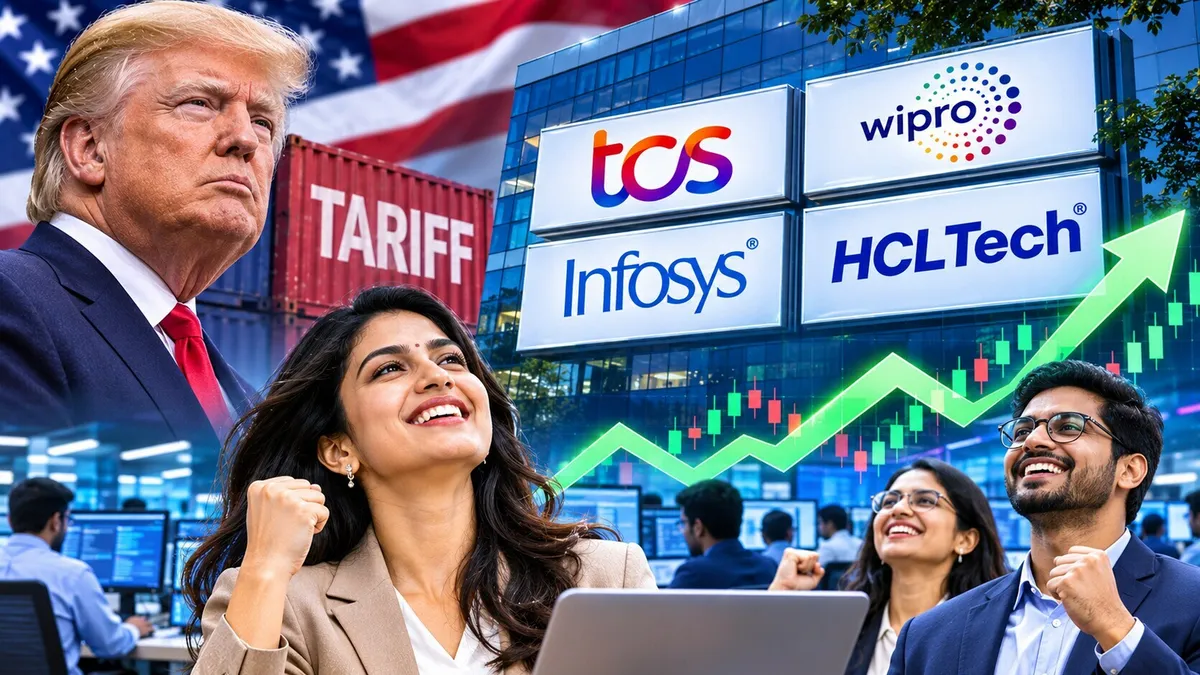
Photo: LiveMint
What happened
Indian information technology shares drew strong buying on Thursday, 26 November, even as a renewed US tariff threat hung over Indian exports. The large-cap names rose as much as 4% in the early part of the session, with Wipro up about 4% and HCL Technologies gaining close to 3%.
Tata Consultancy Services opened with a gap-up at ₹2,523.60 and went on to touch ₹2,590, a gain of roughly 3% in early trade. Infosys opened at ₹1,151 and climbed to an intraday high of ₹1,167.90, more than 3% above its previous close.
The buying came after the Trump administration proposed tariffs on several trading partners, including India. Reports cite a rate of up to 25% on Indian goods in a probe by the office of the US Trade Representative, while US Trade Representative Jamieson Greer has signalled that a bilateral trade deal could cap the duty on Indian imports at 17%.
Key numbers
- TCS: opened at ₹2,523.60, intraday high ₹2,590, up about 3%
- Infosys: opened at ₹1,151, intraday high ₹1,167.90, up over 3%
- Wipro: up about 4%; HCL Tech: up nearly 3%
- Proposed US tariff on Indian goods: up to 25%, or 17% with a trade deal
- Net foreign buying of Indian equities in November: over ₹1 lakh crore
- Price-to-earnings multiples: Infosys about 15.37x, Wipro about 15.43x, TCS about 17.89x
Why it matters for Indian investors
Market experts pointed to two main reasons for the move. The first is foreign money. Avinash Gorakshkar, founder of Avinash Mentor Research, said net foreign purchases of Indian shares have crossed ₹1 lakh crore in November, lifting large caps, including the top IT names in which overseas investors hold big stakes. The second is a rotation within technology. According to Seema Srivastava, a senior research analyst at SMC Global Securities, global tech and AI-infrastructure stocks have been sold on concerns about stretched valuations and the returns on heavy AI spending, while Indian IT companies make their money from services such as software development, consulting, cloud migration and enterprise implementation, not from big outlays on chips and data centres. That has led investors to treat them as a relatively safe place within the sector.
The nature of the tariff threat also matters. Market participants appear to see the US proposal as open to negotiation, and as less of a direct risk to software and services businesses than to companies that ship physical goods. Commentary from officials and the market also suggests the talks are progressing, and that tariffs on goods could hurt industrial exporters more than IT services firms.
What to watch
The key variable is the India-US trade negotiation. A signed agreement would bring the proposed rate down to 17%, while a breakdown would keep the 25% figure in play and could test the view that services exporters are insulated. Investors will also track whether foreign inflows, which have lifted large caps this month, continue at the same pace.
Valuation gaps within the group are another factor. Anuj Gupta, a SEBI-registered market expert, noted that Infosys and Wipro trade at the lowest price-to-earnings multiples among the four large IT companies, at about 15.37 and 15.43 times, while TCS, at about 17.89 times, has stronger valuation support for its quality because of its superior return on equity.
Questions readers ask
Why did IT stocks rise despite the US tariff threat?
Analysts cited net foreign buying of over ₹1 lakh crore in Indian equities in November and a rotation out of expensive global AI stocks into Indian IT services, which they see as less exposed to tariffs on goods.
What tariff has the US proposed on Indian goods?
Up to 25% in a US Trade Representative probe. USTR Jamieson Greer has signalled that a bilateral trade deal could bring the duty on Indian imports down to 17%.
Source: LiveMint report(opens in a new tab), published .
This story was written in our own words by the Finduniya News Desk from the facts in that report, with the help of an AI writing tool. The wording is ours; the original reporting belongs to the publisher.